“In Landlocked, Schmidt offers a profound rethinking of the politics of extraction by turning to Alberta—too often overlooked in global energy debates—as a key site for understanding how states secure and sustain political legitimacy. Tracing the intertwined histories of water and oil, Schmidt shows how geoscientific knowledge has been central to shaping relations to land, Indigenous dispossession, and the governance of resources. Alberta emerges as both a local case and a global index of how environmental knowledge underwrites political authority. Both conceptually ambitious and empirically rich, Landlocked provides a powerful new framework for grasping the planetary stakes of energy, territory, and state power.”—Imre Szeman, author of Futures of the Sun: The Struggle over Renewable Life
“Schmidt’s Landlocked recasts Alberta’s political story as a compelling interplay of oil, land, water, and the geological past. Schmidt shows how oil became an emblem of provincial identity and a claim to political legitimacy, and he introduces the concept of ‘landlocked thought’ to illuminate how patterns of extraction shape governance, Indigenous dispossession, and environmental decision‑making. Focusing on the development of Alberta’s two most valuable natural resources, Schmidt demonstrates how water and oil helped shape Canada’s settlement, legal regimes, and energy strategies, and how Alberta drew on global science, norms, and technologies to sustain its claims. Rigorous, richly researched, and intellectually ambitious, Landlocked offers a powerful new framework for understanding the ties between environmental knowledge and political authority and will reward scholars and engaged readers in energy policy, political history, and environmental studies.”—Paul Chastko, author of The Boom: Oil, Popular Culture, and Politics in Alberta, 1912–1924
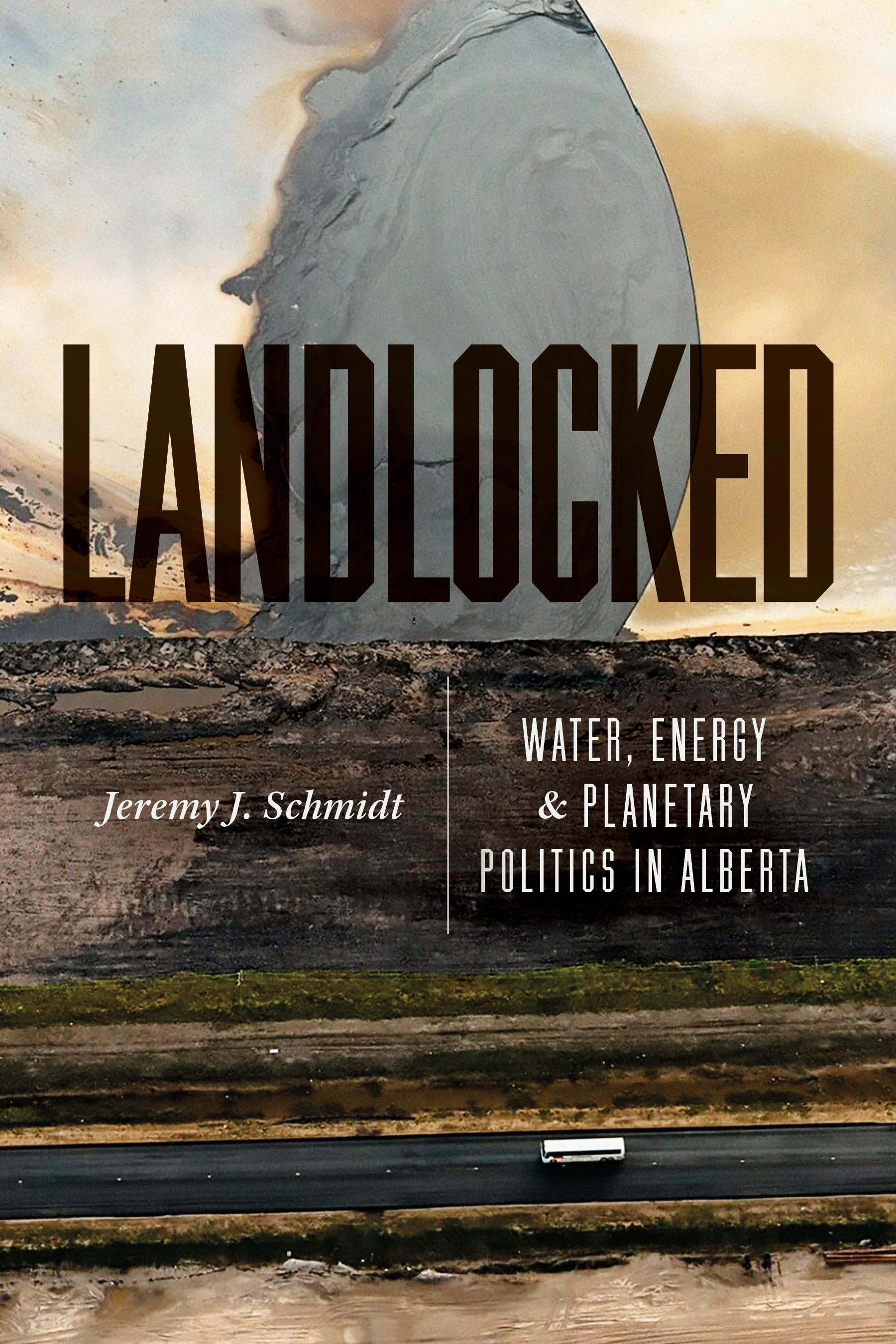
A study of oil-rich Alberta reveals the entwined relationships among geoscience, governance, and power.
The Canadian province of Alberta holds the world’s fourth-largest reserve of fossil fuels, with oil sands famous for bitumen, a viscous form of petroleum. A critical testing ground for international environmental ideas and energy policies, Alberta pioneered state-led efforts to understand, extract, and sell bitumen. Without natural access to ocean ports, Alberta must negotiate pipeline routes with neighboring provinces and nations to reach global markets. But Alberta is also landlocked in another sense: it is caught in an extractive relationship with oil-rich earth.
In Landlocked, Jeremy J. Schmidt focuses on Alberta’s energy industry, particularly its use of water and oil, to argue for a new way of understanding how political authority is forged and maintained through the environment. Schmidt details how water and oil were enrolled in early state-making projects, such as irrigation, and examines the consequences of Alberta’s efforts to extract value from land, including a series of events in 2013 that released 4.2 million barrels of bitumen into underground environments. By uncovering the ways that geosciences supported activities—from land settlement to the dispossession of Indigenous peoples—that produced environmental policies and approaches to management and governance, he shows that they aren’t merely instruments of state power but central to Alberta’s political identity and legitimacy.
Available September 2026 from the University of Chicago Press.

